Complete guide to kidney stone types, symptoms, laser treatment (RIRS), PCNL, and prevention
There's no single best treatment — it depends entirely on stone size and location. Stones under 4 mm often pass on their own with fluids alone; larger stones typically need laser treatment. Two minimally invasive procedures cover almost every case: RIRS (flexible ureteroscopy) for stones up to about 2 cm, and PCNL for larger or staghorn stones. Both use small or no incisions, and stone size on CT or ultrasound is what determines which one applies to you.
It depends on size. Stones under 4 mm pass spontaneously in about 80% of cases. Stones 4-6 mm pass in roughly 60% of cases with medical expulsion therapy (alpha-blockers like tamsulosin) and drinking 2-3 litres of water daily. Stones over 6 mm usually need an intervention like RIRS or PCNL rather than waiting.
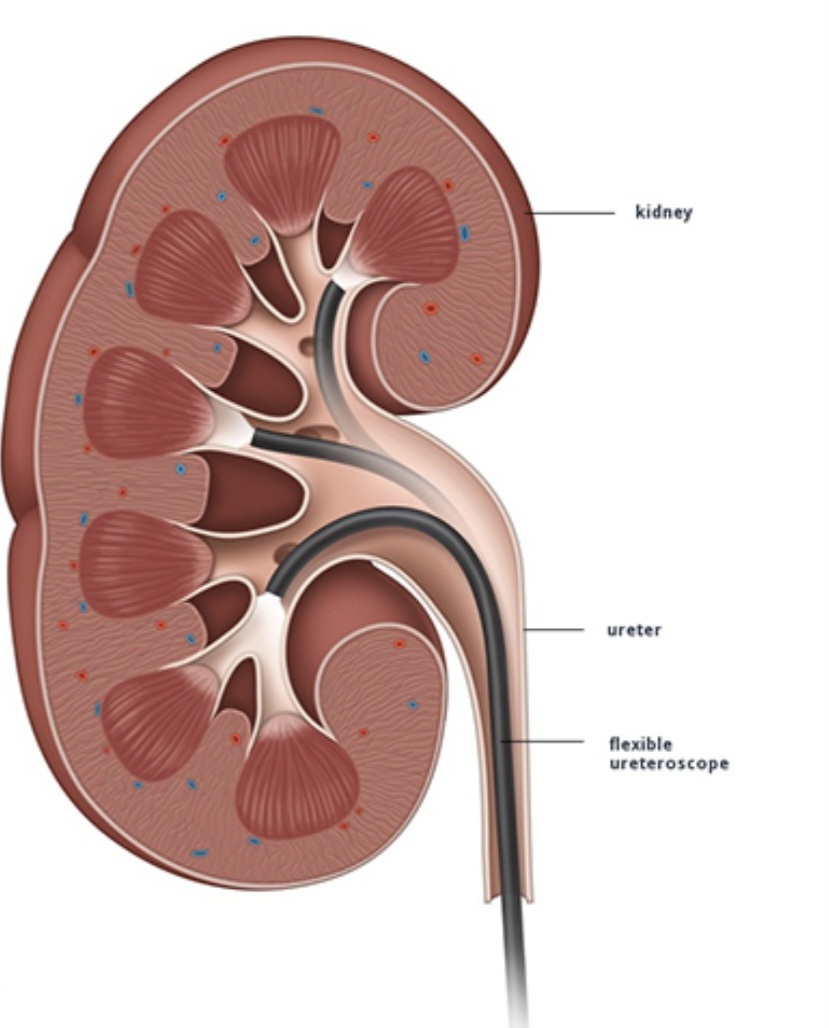
RIRS (flexible ureteroscopy) is used for stones up to about 2 cm — a flexible scope reaches the kidney through the urethra with no incisions, and a holmium or thulium laser dusts the stone, often with same-day discharge. PCNL is reserved for larger stones over 2 cm or staghorn calculi — it accesses the kidney through a small puncture in the back and typically involves a 1-2 day hospital stay. Stone size and shape on imaging determines which technique applies. This size-based approach follows the EAU Guidelines on Urolithiasis (2024) and the AUA Surgical Management of Stones Guideline (2016, amended 2019), both of which base first-line treatment choice on stone size and location rather than a single fixed technique.
Without prevention, half of patients have another stone within 5 years, and 80% within 10. The core measures: drink 2.5-3 litres of water daily so urine stays pale yellow, reduce salt and animal protein, and follow stone-type-specific guidance (less spinach and nuts for calcium oxalate stones, reduced purines plus allopurinol for uric acid stones). With proper dietary and medical management, recurrence can drop by 50-80%.
Kidney stones are hard mineral deposits that form inside the kidneys when urine becomes highly concentrated. They range from tiny grains to large staghorn stones. Most are calcium oxalate, but can also be uric acid, struvite, or cystine.
Calcium oxalate (70-80%), calcium phosphate, uric acid stones (linked to gout), struvite stones (from infections), and cystine stones (rare, genetic). Stone type determines the best treatment and prevention strategy.
Renal colic — severe flank pain radiating to the groin — is the hallmark symptom. Others include blood in urine, nausea, vomiting, frequent urination, and fever if infection is present. The pain often comes in waves.
Low-dose CT scan is the gold standard, detecting all stone types and sizes. Ultrasound is used for follow-up without radiation. KUB X-ray and urine analysis are also used. A 24-hour urine collection identifies metabolic causes.
Stones under 4 mm pass spontaneously in 80% of cases. Stones 4-6 mm pass in about 60% with medical expulsion therapy (alpha-blockers like tamsulosin). Stones over 6 mm usually need intervention. Drinking 2-3 litres daily helps.
Have more questions? Book a consultation with Dr. Samer Morsy
💬 WhatsApp Dr. MorsyRetrograde Intrarenal Surgery (RIRS) uses a flexible ureteroscope passed through the urethra to reach the kidney. A holmium or thulium laser pulverizes the stone to dust. No incisions needed. Ideal for stones up to 2 cm, often same-day discharge.
Percutaneous Nephrolithotomy (PCNL) is used for large stones (>2 cm) or staghorn calculi. A small puncture in the back accesses the kidney directly. Mini-PCNL and ultra-mini-PCNL use smaller tracks for less morbidity. Hospital stay is 1-2 days.
After RIRS: home same day or next morning, ureteral stent for 1-2 weeks (mild discomfort), full activity in 1 week. After PCNL: 1-2 days hospital, nephrostomy tube 1-2 days, normal activity in 2-3 weeks.
Drink 2.5-3 litres of water daily (urine should be pale yellow). Reduce salt and animal protein. For calcium oxalate: limit spinach and nuts. For uric acid stones: reduce purines and use allopurinol. Follow a metabolic evaluation-guided diet.
Without prevention, 50% of patients have a recurrence within 5 years and 80% within 10 years. With proper dietary and medical management, recurrence can be reduced by 50-80%. Annual kidney ultrasound and urine analysis guide long-term prevention.
Ready to take the next step? Book your appointment today
📅 Book Appointment